Once again, it appears as though the Bohemian’s got it in the bag. His innovation continues to impress.
After a year of gardening, our plot has become thick with roots from neighboring trees. Seeking the water and nutrients we bestow upon the garden, their root systems have infiltrated, competing with our plants and tangling our fluffy beds.
The Good Neighbors dealt with the same issue, and decided to dig a trench around the circumference of their garden, inserting a strip of metal to block encroaching tree roots. It’s worked well for them, but it seemed pretty work-intensive for our immediate needs.
An alternative was to create raised beds. But unless we scavenged for our own wood or logs, this would be a few hundred dollars in lumber to build. Additionally, we would eventually be left with sinking soil levels in the beds. Again, a big job and fairly costly.
Ultimately, we just wanted to get some fall crops growing while we were still in the pocket of time to plant. With so many projects on the table, the Bohemian was thinking ‘work smarter, not harder’ and ‘use what’s around.’
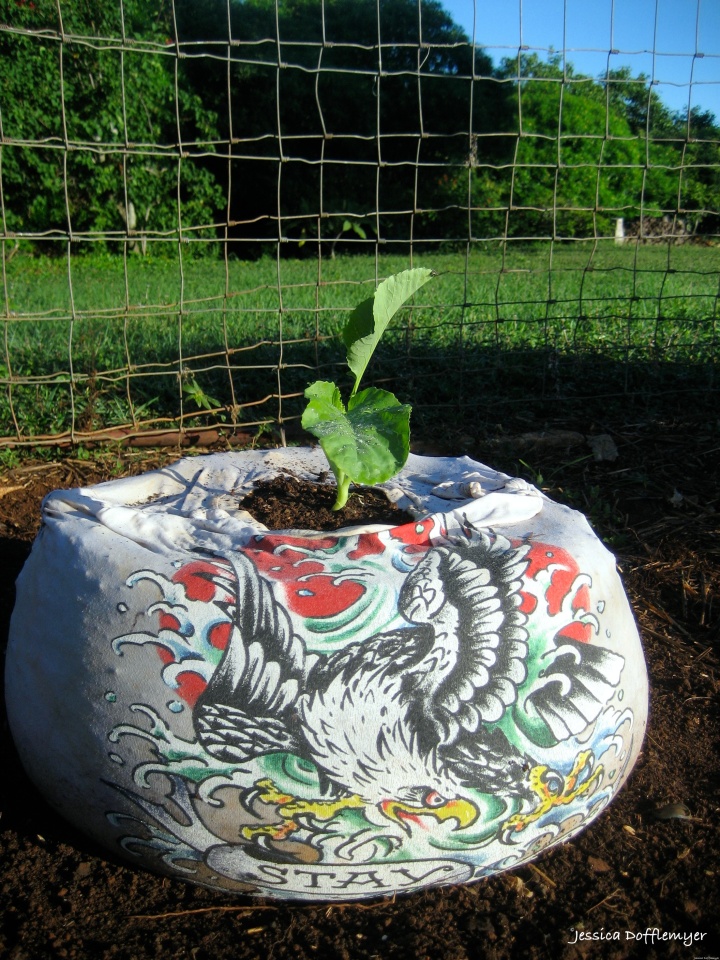
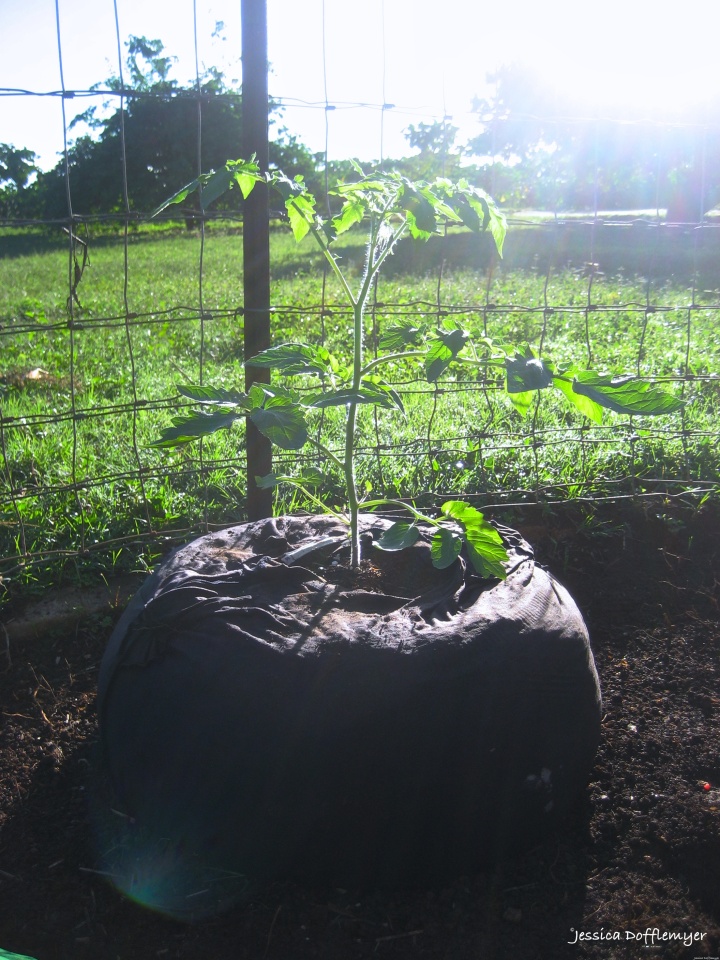
Hence, old t-shirts from the giveaway pile, are now housing tomatoes and cauliflower. He used twisty-ties to knot up the sleeves, and filled them with a mix of our rich garden soil, along with his fertilizing worm castings.
Yep, the theory is that this bag of soil will suffice in giving the plant everything it would have in a raised bed, with the added benefit of the t-shirt material holding moisture in the soil.
His solution still doesn’t address the creeping tree roots beneath the garden bed, but it is an immediate solution for our family, that just wants to grow some food this season without a lot of fuss.
I don’t think he sweat a drop, and it didn’t cost us a penny. In fact, it up-cycled some old t-shirts that were cluttering our closet.
It’s an experiment in process, and we’ll see if it bears fruit.
In a transparent revealing of my stream of consciousness, I’ll share that this morning’s writing exercise has left me only with thoughts of the roses at the Self-Realization Fellowship Lake Shrine in Malibu, California.
Dedicated by Paramahansa Yogananda in 1950, the Bohemian and I visited the temple in May 2012. Beautiful and serene, we soaked in the calm and smelled the roses.
These roses appear in my mind, as a quote from Yogananda is given via the Lake Shrine Temple’s website:
“Come into the silence of solitude, and the vibration there will talk to you through the voice of God.”
I believe God can be found in the fragrant folds of these petals, sharing an infinite supply of stories.
This morning I’m thinking about how simple function can still be artful. That creations built purely for function can actually be elevated to art form, by way of their pure inventiveness.
The Bohemian would not necessarily call himself an artist, but his inventions, ever-practical in their execution, are simply exquisite.
Take his current passion- worms. He began with seven of them and a mound of soil. He has increased their numbers over the last year and a half to tens of thousands. They live off of what we discard: paper, cardboard, and kitchen scraps. What they give us in return are their ‘castings,’ or poop. Worm castings are an excellent source of fertilizer for all plants, and a great enrichment for the soil. Worms turn our trash into treasure.
And what the Bohemian has done to support the worms is also a demonstration of his artful ability to create functional tools from other people’s waste. His evolving worm farm shows that even the most functional of construction can certainly be rooted in artistic vision.
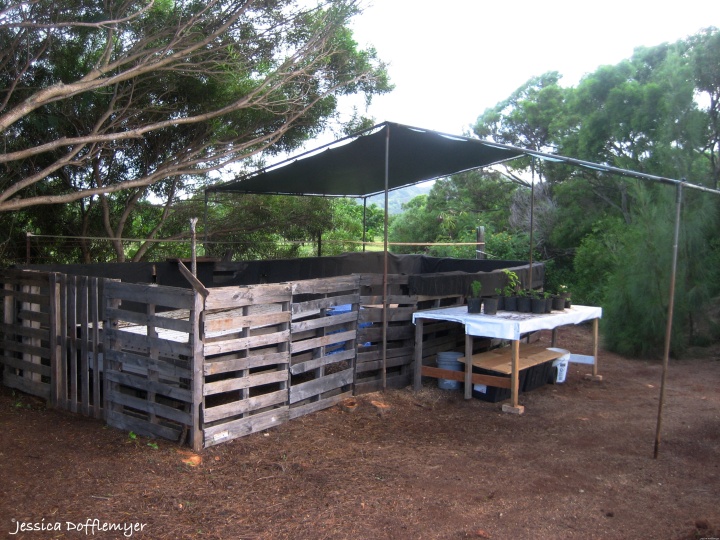
the worm farm
This is the worm farm, the Bohemian’s epicenter. Originally it was a small clearing in the trees. He has significantly expanded the space over the last year.
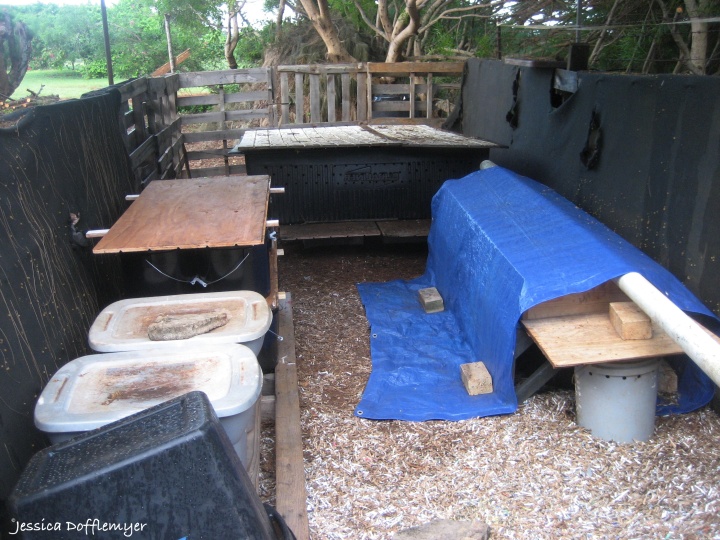
inside the worm farm
It began with reclaiming an old truck bed liner and putting it on blocks. He drilled air holes on the sides and it became the home for the worms. The surrounding pallets were all in the give-away pile, now serving as a fence to keep out wild pigs. The black cloth on the sides is old ground cover that was slotted for the dump. Under the blue tarp is an unwanted bathtub, which now acts as a drying station for the castings. All of the wood you see were scrap pieces left over from other farm projects, which the Bohemian gathered and utilized.
Notice the shreds on the ground inside the interior of the area? That’s cardboard and paper. Our family never takes paper or cardboard to the recycling center, because the Bohemian regularly shreds all of it with a basic, office-style paper shredder. We have mounds of the stuff. And it’s a key ingredient in keeping the worms fed and giving their home a balanced moisture.
It’s apparent that I am in awe of my husband’s inventiveness. I know I’m biased in my showcase, here. But even if the man were not the love of my life, I would still be most impressed with how one human expresses the creative spirit through purely functional means.
Hence, his most recent invention, the sifter. With the worms now producing a large amount of castings, the idea is to have a machine that can sift the clumps, separating any cocoons or stray paper pieces. This saves time and energy when dealing with large batches, and produces a finely sifted fertilizer with a multitude of uses in the garden.
The sifter that the Bohemian thought could do the trick was available online for $2,500, not including shipment to Hawaii. As I was slicing red peppers in the kitchen, he was carefully studying the images of this machine on his iPad. Not long after his web search, he’d wandered downstairs to the garage, where soon the sounds of drills and saws were drifting to my ears from down below.
What ensued was just as focused, passionate, and brilliant as any painter splashing color across a canvas. For days, he was coming home from work and moving straight to the sifting machine project. He would work into the night, long after dark. Sometimes I would bring him water, as he was so enthralled with his creation, he’d forget to drink.
Not everyone can build structures. For those with the knack, they typically go to a hardware store and purchase the materials needed. It takes a special kind of builder (a very artistic one, I would venture) to know what materials are needed, and to then try to find them in the discarded scraps of what other builders have tossed aside.
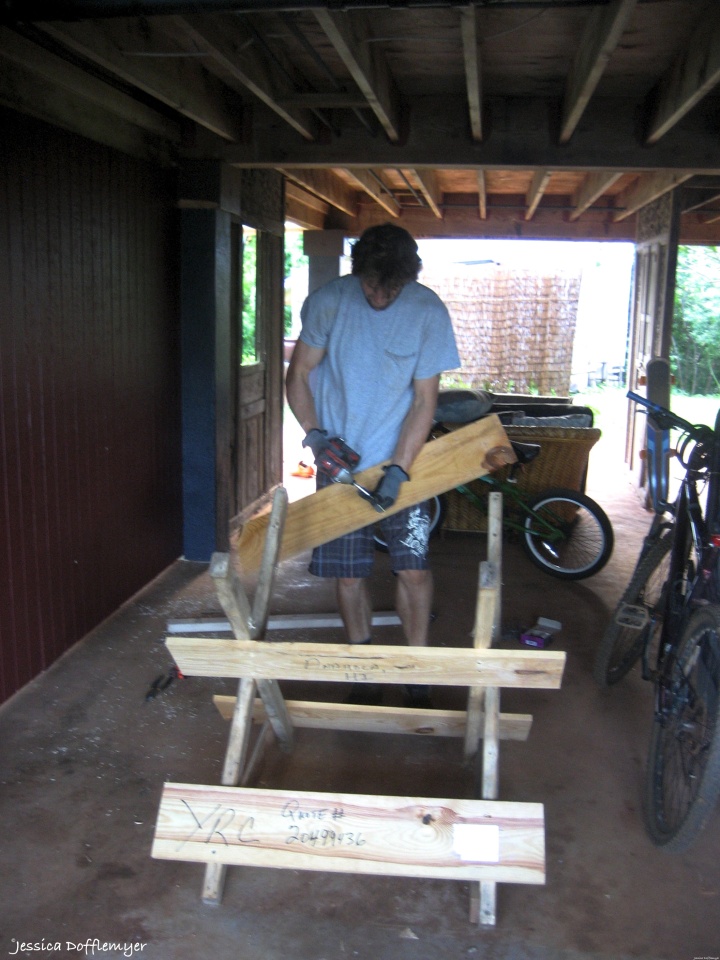
The main frame of the Bohemian’s sifting machine is all built from wood that was the crate housing a huge piece of machinery delivered to the farm last year. At the time, he offered to disassemble all of the wood planks and brought them home for future use.
early stages of the sifter project
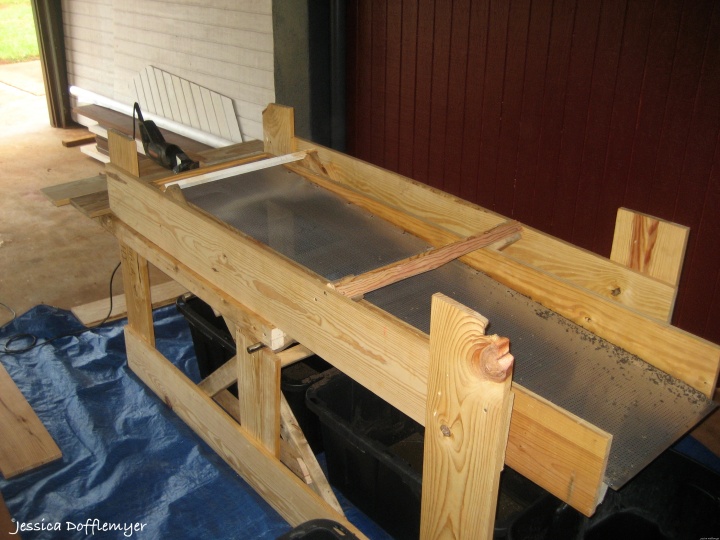
Other pieces of the sifter come from old PVC pipe and an abandoned curtain rod. He did purchase the screen, itself, when he found that using vinyl window screen was not solid enough for the job. The motor of the sifter is a sawzall that was left behind by a previous tenant at our house.
making progress
The video below, is only phase one of the sifter project. Since the filming, he’s already added wheels for smoother traction, adjusted the angle of the sifting bed, and modified his catchment system underneath. The footage is amateur, but hopefully it conveys the magic I sense when I see trash become treasure, as it is constructed to be of use, rather than waste.
The worms are experts at this. And, clearly, so is my husband.
Function that is artful and greatly needed in a disposable world.


 For the Archives