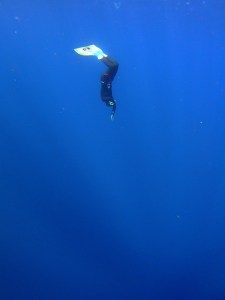
I’m free diving
letting bubbled liquid
fill my ears
to heavy quiet
but for the tinkling
of sand
sifting
my body
moving
with the rocking sway
of currents
I float
through thick space
maneuvering in the blue
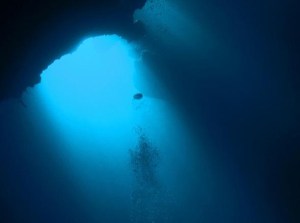
streaming sunlight
that casts holographic hallways
azure passageways
through which
I slowly swim
in the water world
there is weighted silence
and dazzling sights
prisms of light
courtesy of gnews
If I were to open my mouth
to tell you
I would be drinking a salty soup
in this bluish realm
I can only
slowly
make a gesture
toward the essence
of this calm
later will be the surfacing
a gasp for breath
teeth exposed to air in smile
rivulets of salt streaming
to an open mouth
a tongue to tell
“If you start to sink, just push your heart to the sky.”
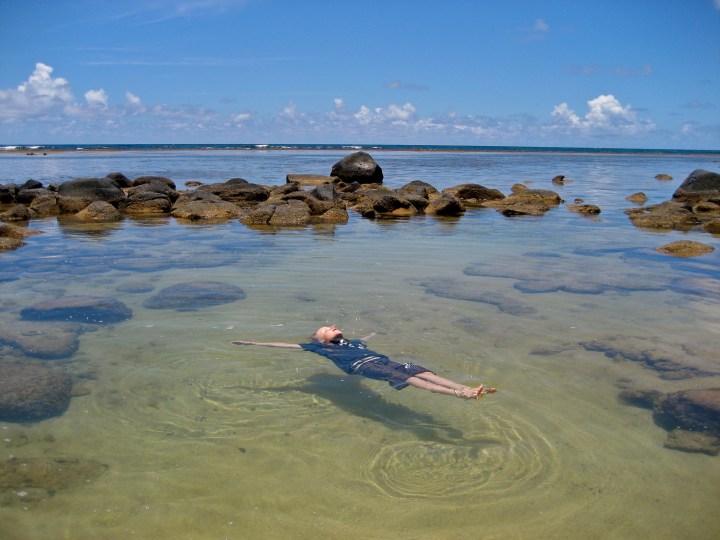
I’ve got one index finger on Jeb’s lower back as he stretches out in salty liquid. We’re in the ocean and he’s trying to find the sweet spot that enables one to float. Arms outstretched to either side, head back, I can feel him trying a little too hard. It’s natural to want to help the water hold you, but in truth, if you want to float, you have to surrender and trust it.
His sternum curves and his heart pops through the surface of the water. His body instantly has more buoyancy.
“That’s it, exactly! See, you could float there all day, no problem,” I say, still holding one finger on his back in support.
“Ok, you can let go,” he says, his face earnest, his lips curving in a faint smile.
I release my finger and watch him stay afloat. I see the water buoy his frame, his body relaxed and calm.
He smiles wide. “This is better than a couch!”
Jeb’s been in the ocean since he was 17 days old. He can read the timing of the waves, surf with his body and a board. But he doesn’t like to go where he can’t touch the bottom. And he’s never fully grasped the perfect balance that allows his body to be held by the water.
This milestone is monumental. Its importance is revealed to me even more throughout the rest of the day, as snippets from Jeb hint at bungled lessons from his dad on the art of the float.
“Dad said to hold my breath and keep my feet up…but with you, I could breathe the whole time. I like your way, Mom. Now I know for sure, the ocean is my home.”
I get a sense that one of these floating lessons may have occurred this past weekend when Jeb and his dad took an ocean kayak trip to a remote coastline. It’s an adventure people save for years to experience and Jeb had an amazing time, returning from the journey markedly matured. An expert waterman, Jeb’s father offers him ocean and boat knowledge I have no clue about.
But sometimes in life we need to learn from someone other than the expert. Sometimes it’s just a random person with a simple phrase that can shift our understanding and bring a revelation.
In this instance, I am that random person still learning the metaphors of what I’m attempting to teach.
Listening to my own words there in the water, I loved hearing what spilled out. My suggestion that Jeb reach his heart through the surface, was what enabled him to find that perfect place where he could relax and the water could hold him.
On Independence Day, Jeb has a breakthrough and learns to float. I’m reminded to keep the heart as my compass and then simply let go.
A man with a boat gets a call about Hawaii’s tsunami warning, letting him know he needs to move his vessel. There is no safe harbor. The best course of action is counter-intuitive: take his boat out to sea. So the seaman motors further out into the ocean, spending the night on the vast, tumultuous water.
This story is told by the boat man’s mother, who was up all night afraid for her son’s life. By morning, he and the boat had made it through the surges just fine.
Would the boat have tried to position itself in the safety of the harbor, it may have run aground in the receding waters or been smashed to pieces with the ensuing tidal swell. Clinging to the shore was dangerous. The most wise move was to leave the shelter of the harbor and forge out to meet the waves. He needed to travel to depths so far that the boat would simply float among the surges.
In my own emotional fathoms, I sense the tendency to want to stick close to familiar shores. But it’s true that though the shoreline may feel familiar, I’m lingering right in the impact zone. Could it be that the more I hold on, resisting the deep unknown sea of me, the more I get tossed about in the white water wash? It’s dark and deep and scary out there. Do I dare move toward the unpredictable when all systems have declared a massive wave of unknown proportions is on its way? Is being vulnerable really the safest move?
The seaman says yes. Cruise right out there and float.


 For the Archives