“I think you could all agree that I tried. To be true. To be strong. To be kind. To love. To be right. But I wasn’t And I know you knew this, in each of your ways. And I am sorry. All is lost here, except for soul and body. That is, what’s left of them. And a half day’s rations.”
~ Our Man, “All Is Lost”
I watched the movie “All Is Lost” on Mother’s Day. Not exactly an intentional choice, but it was the DVD that was at the top of the Netflix queue that weekend. So Jeb, the Bohemian, and I hunkered down at the end of the day for this award-winning survival tale.
Robert Redford is the one and only character, as “Our Man,” a sailor, alone at sea. There is no dialogue, just the portrayal of a man on his boat, and the series of events that unravel after colliding with a floating shipping container.
I think this is where I give the “spoiler alert” warning (if you have yet to see the movie and don’t want to know details, pause your reading now).
The movie has been with me for the past few days, as I reflect, most specifically, on the ending. The film takes the viewer through the progression of events that begins with a hole in the boat. What ensues is a series of incidences, that despite his efforts, Redford’s character cannot surmount. As soon as he remedies one problem, another arises, as he swiftly loses one security after the next.
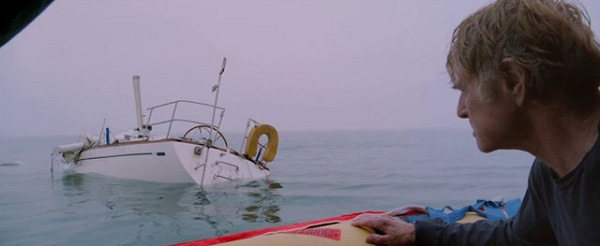
Eventually, he is left with only a leaking raft boat, drinking the condensation from the salt water he creates, using sunlight and a plastic bag.
Finally, with nothing left to eat, a last, remote hope appears in the distance. A light from a ship in the night. He’s able to ignite a fire, that he then fuels with the pages from his log book. In his attempt to feed the fire, trying to be seen, the flames get out of control and engulf his life raft, sending him overboard into the dark waters.
But for his own heart beat and breath, now, in this moment, everything is truly lost.
What to do?
Our Man has reached the point beyond doing. There is nothing to do, it seems, but to surrender. Let go. Release.
And he does. He lets himself sink into the shadowed depths, falling, slowly. Dropping down.
As he drifts downward, he can look up toward the surface and see his circular life raft aflame, a ring of fire. He has been burned by circumstance and sun. Stripped of everything he thought significant. He has passed through flames into the abyss of water, where his life is transforming. Everything he knows is dying.
It has been depicted in some epic tales that only through complete and pure surrender, have the greatest realizations been attained. There is the story of a man earnestly seeking Truth by sitting under a tree, then finally giving up his quest altogether. Once he relinquished his grasping grip, he became enlightened as the Buddha. Or the story of Jesus on the cross, completely giving himself over to the experience of a long and torturous death, only to rise from that passing with life, ever-lasting.
Whether you literally believe these stories or not, the alchemy of pain and struggle into freedom is a metaphor that’s been woven in tales throughout human history. The legend of the Phoenix bird rising from the ashes is a classic story of unbounded potential emerging from a fierce forging. A prize only attained through the complete release into the flames.
Only as I am writing here, am I realizing the significance of watching “All Is Lost” with my son on Mother’s Day. How the final scene in this movie, as Our Man plummets down into the ocean’s black abyss, is one in which I can relate to in my own way.
I have my version of the plummet on the day my son was born. The moment when the mid-wife had checked his heartbeat as he was still in the birth canal, crowning, but not yet born. How she asked me to call upon whatever Powers that I needed to help me birth my baby. That the time was now. He needed to emerge. All of the magic and phenomena I could muster, must be called upon to bring my child into the world.
And when I asked for help from every deity of every lineage I knew, what I heard and felt was nothing. What I saw in my mind’s eye, was a vast and infinite tunnel of blackness, through which, I was quickly falling. There was nothing to hold to. Nothing to grasp. Nothing to help me.
For years I struggled with this birth experience (my son was born healthy and well – so Grace was with me somewhere I like to think). I questioned myself. I believed I’d done something innately ‘wrong.’ That I was so far adrift, I didn’t even know how to pray correctly, at the time of life and death, when I needed it most.
I told this story to a woman who was a Buddhist. She had become blind in the middle of her life, then later, regained her sight. She knew, intimately, about the darkness.
When I expressed my sadness and confusion around having felt not a thing in one of my life’s greatest hours of need, she asked with wonder, “You got the darkness?”
Awe and whisper in her words. “Not everyone gets the darkness.”
Robert Redford’s character, got the darkness. The nothingness. And just as he slipped into all its mystery, he looked up to the surface to see that boat with a light approaching his blazing life raft. Far down with little oxygen, he makes one final attempt.
He swims towards the top, pushing through water, kicking his way back to air.
The final sequence is left to interpretation.
A hand from the boat reaches into the water. Our Man grasps the hand.
The screen shifts from the black, watery shadows to a flash of bright, white light. The film ends.
Was he rescued?
Or did he die trying to reach the surface, the helping hand, only a part of some afterlife illusion?
The movie lets you choose how you want to see it.
Just like life.
So my Mother’s Day delve into “All Is Lost” was unintentional but poignant. I’m still mulling over my birthing story and all that wasn’t there. And all that was (most beautifully, my healthy son, now 10 years old and growing).
When all is lost, is Nothing left?
What is that Nothing?
 For the Archives