“Do you know how to play 52 pick up?”
This question is posed by my smirking step-brother who holds a deck of cards in his hands, circa 1983.
“No,” I say.
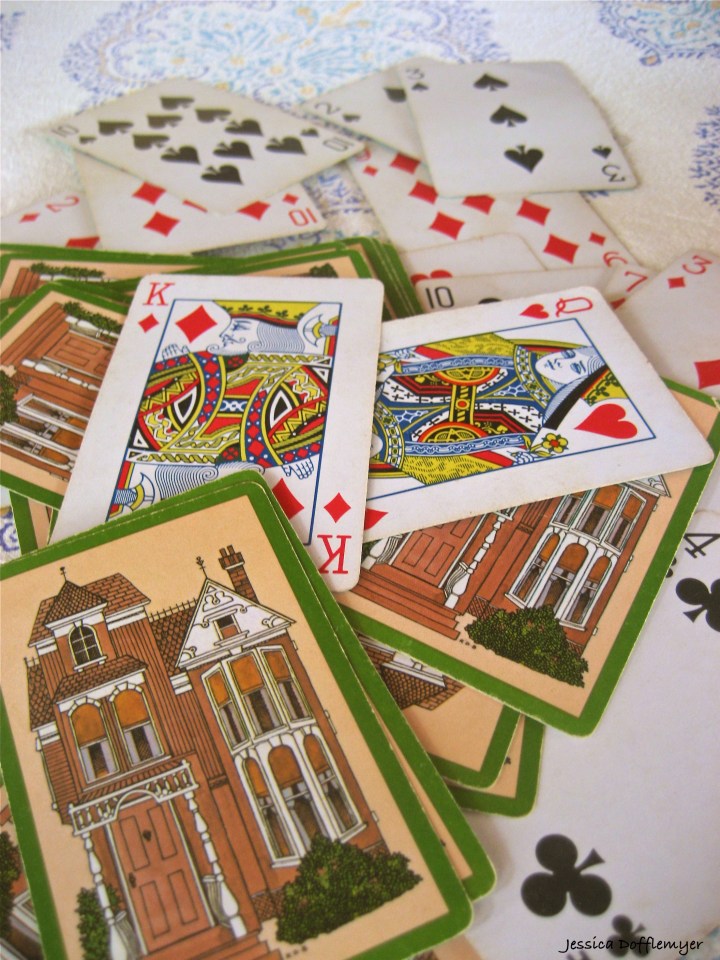
With thumb and forefinger he sends them shuffling through the air in random abandon, landing in a chaotic pile on the table.
“Get it? 52 pick up?”
Right.
If my life is a deck of cards, then perhaps 52 pick up is the game I’ve mastered. The airborne shuffle, that is, not necessarily the clean up.
As the Bohemian and I share a four-day reprieve of non-parenting days while Jeb’s away with his dad, I ponder how I’ve done it all out of order.
Honestly, I dreamt of the stereotypical, American life. I wanted marriage, a house, children. But I couldn’t be normal about it. I got engaged (diamond ring and all) when I was 16. Then didn’t really announce it (we’d wait to wed til after college anyway).
But I was on the path to normal. I’d get my degree, get a good paying job, marry the man I loved, and start a family. Seemed a simple formula for happy-ever-after.
Except my fiancé started an affair with the goth-girl at one of the chain bookstores in the Fresno mall (detailed account of this liberating break up in Crumbling Empires and Parked Cars). At 19, my engagement ended and my little ordered timeline was severely jumbled.
Once I left Fresno, I guess nothing really stayed inside the lines of predictable. I attended college for three years but left before getting my degree. I travelled by myself all over north america, working odd jobs and occasionally living out of my car. I longed for true love but questioned the precepts of monogamy.
By 29, I was in Hawaii living in a school bus, up on blocks, with a boyfriend who professed love but wasn’t sure about commitment. Though my closest friends were all married, I was the first to give birth. And nine months later, I had separated from the father of my child and forged into the realm of single motherhood.
By 39, many friends were at least a decade into their lives of married with children. I’d been piecing housing situations and jobs together. Though I’d been doing it in Hawaii, it was still hard as hell- building character, of course. I can’t help but look back and think that somehow, I was simply prepping myself for a future life with the Bohemian.
The announcement of my pending marriage, was often met with great support from friends coupled with undertones of wariness. Like when a dubious sigh meets the words “good luck.” Not sarcastic. More like hopeful skepticism. No one dared to actually express this blatantly, but I could tell that all-too often, ten plus years of matrimony can take its toll.
As I come to my 40th birthday, I’m a newlywed with a 9-year-old. We never had an official honeymoon, so we take the four days this week without a child to just be husband and wife. Niagara Falls is not in the equation. In fact, just about everything is business as usual.
So we work with what we’ve got. Sunset and an empty house. Why not leave the dishes and crawl under the covers before the sun goes down? Make jokes and stay up late on a weeknight? Have an ordinary kind of unconventional honeymoon?
I guess what has not yet been said here, is that for me, I don’t think ‘normal’ was in the cards. Try as I may to keep things ordered and straight, life has tossed my plans about in delightful whimsy. And if I look deeply, I can see that I wanted it this way. I never truly desired the status quo.
But for a long time, I was thinking that my less-than-typical life was a reflection that I was doing something wrong. That if I didn’t fit the mold it was because I was misshapen.
As I move into my fourth decade on planet earth, I’m so glad I did it all backwards. I let the cards fall where they may and found inspiration in the pile. It’s still a work in process, and I’ll probably spend a lifetime sorting through it.
It can be a fun game to play. Especially when you let go of straightening it out.



 For the Archives