I’m walking down a steep incline beside my teetering toddler with a machete in my hand. It feels just like it sounds- dangerous and vulnerable. We’re heading into the jungle.
I’ve been eyeing the rack for a week now. I pass the banana tree daily and see the yellow hands slowly being picked away by the birds. The fruit is ripe and ready but I’m wondering how I’m going to get it. In my seven years living on this island, I have cut down many banana trees. It takes some muscle but not a lot of brawn. Harvesting bananas entails cutting down the whole tree, slicing into its soft, sinewy stalk, which is thick, watery and heavy. After the banana rack is taken from the tree, the trunk is chopped into small pieces fertilizing the soil for the new tree that will grow from the stump of the old.
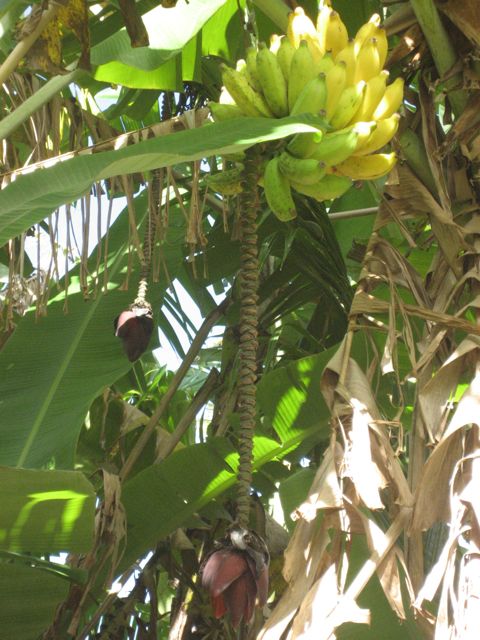
I usually find a kind of primal strength in using a machete. There’s a certain power in holding the tool in my hand; strong and well-equipped. With this tool, I can feed myself and carve a path. For all my past banana felling experience, now bringing my nineteen month old, a hillside and a machete all together has me a little nervous. I am being responsible? The fear-induced, worry-mind asks the typical litany of questions: What if Jeb gets hurt? What if I slip and fall down the ravine? What if the tree falls on the fruit and we loose it all?
These doubts have been my excuses. As I have seen the empty brown peels, hanging limply on the rack, devoid of fruit, I have lamented to myself, that if only someone could watch Jeb while I cut down the tree, not a single banana would have gone to the birds. It’s a tired complaint that continues to rear its insecure head, reverberating like a gong that stalls my strides: If only someone was here to help me.
I have passed this rack one too many times and though it looks as though I’ve lost at least one entire hand of bananas to nature, I can’t let the whole rack become wasted. So here we are, rambling down this steep slope together; me, my son and a machete. Jeb loves to teeter down, though I make him hold my hand. I grip the machete on the other side of me, aware of all its potential. I repeat out loud about the machete being sharp.
He echoes, “shawp”.
I tell him he’s going to help me cut down the banana tree.
“Nanas”.
I’ve spent the last 15 of my 32 years proving to myself that I have the capacity to rise to a challenge. My travels alone throughout North America and India proved that I can survive. Experience has shown me that at often at my most vulnerable times, surrendering to trust can be my greatest strength. Now, as I raise my son alone, this trust is tested to include supporting the life of another.
Do I have the ability to raise a conscious, healthy son who can contribute to our world with love? Lurking in the depth of my core are the fears that I cannot do it on my own. How do I do this? What if I fail?
When we get to the banana grove, I see the tree is in an awkward position. Its full rack hangs heavily above a deep ravine. The soil is loose here in the undergrowth, slippery dry leaves and roots zig zag across the steep jungle floor. I’m taking careful steps with a toddler in one hand and a machete in the other. I plant my feet strongly on the incline.
I seat my son on the ground in a safe flat spot and ask him to be a helper while I cut down the tree. The questions and doubts fire their rounds: Is this safe? I ponder the millions of mothers before me and what they have faced with their children in the natural world. I hand Jeb a small banana from the place on the rack I can reach. I can feel his sense of the importance of our mission, his knowingness that this is a time to do as I ask. And he sits there, in his spot, while I assess the best way to fell the banana tree.
Jeb and I face the proverbial jungle everyday. As he stumbles over his own feet, I crawl through the undergrowth of my past. I relive my own childhood as I spend these days with my son. In the moments when frustration peaks, I face my father’s rage and command: Stop crying or I’ll give you something to cry about. I feel my mother’s victimization: Your father left me. In moments of impatience I hear a snapping tone in my voice. I watch the thoughts in my head, angry at Jeb’s father for not being here to help me. And every time my son, in a place of pure need, whimpers and reaches for me to pick up his 30 pound frame, I am faced with the small girl within me who longed for her affection. It’s a jungle in the world of motherhood and you’ve got to watch for hidden vines, sleeping snakes, wild panthers.
In this tropical paradise, though, there are no predators. In this jungle, there are wild ginger flowers, a flowing stream, singing Shama birds and a banana tree heavily laden with fruit. Seated in the midst of this jungle is my son, his soft blond hair curling down at the sides of his neck, his tender, round mouth, smiling. In this jungle, there is a bounty of bananas to be harvested. The tool is in my grasp, the fruit is before me, I just need to do it.
The tree is growing between two other stalks, so it is difficult to give the machete a full swing. I take care not to hack at the other trees, which are still waiting to fruit. I decide to pull the stem that hangs from the rack with one hand, angling the fall away from the ravine. I continue peering over my shoulder between cuts to see Jeb sitting in the soil, mushing on the banana, watching intently.
I tell him he is a great helper and say, “We’re cutting down the banana tree!”
“Cut!” he responds.
In a surprisingly short amount of time, the tree is down, the banana rack, intact, and I’m ready to carry the 25 pounds of fruit up the hillside. That familiar primal feeling is back and racing through my blood. The fear and trepidation have been replaced by a sense of self-sufficiency, grace and inner strength. We are feeding ourselves, on our own, together.
Jeb is thrilled with the rack as he repeats “whack”.
“That’s right, it’s a banana rack. You just helped me cut down the bananas.”
“Nanas!”
With my arms full of fruit, he doesn’t even ask to be carried, walking back up the hill beside me. He’s practiced on this hill and doesn’t need my hand. I’ll go back for the machete, which I left by the felled banana tree, on a second trip.
We share an unspoken pride as we walk, which comes through his beaming smile as he says “Nanas.”
Once at the top of the hill, we sit side by side, the rack of bananas as tall as Jeb, like a trophy between us. I sigh and we taste the fruit of our labor.
As the adrenalin settles in my veins, mixing with the sweet goodness of the ripe banana on my tongue, no woman is an island, flashes through my mind. From this hilltop perch, I can see the blue water of the Pacific in the distance. The summer sun is hot on our hair, the trade winds blowing lightly on our bare legs.
Jeb works the peel of his second banana and I don’t move to stop him from indulging in our prize.
“Wow! We harvested some bananas, Jeb. You were a great help.”
Smiling through banana mush lips, he reaches over to place his sticky fingers on my knee. Still learning to pronounce the letter ‘l’, he echoes proudly,”Hewup.”
August 2005
 For the Archives